|
|
Joined: Apr 2002
Posts: 13,367
Veteran
|
|
Veteran
Joined: Apr 2002
Posts: 13,367 |
Very true!
Oleg would have saved himself so much grief, if he had just included tracks of flying the major planes correctly. A track with take off commented, correct climbing, commented changes of supercharger and mixture settings, commented WEP, etc. Just a few tracks with texts and voil�.
|
|
|
|
|
Joined: Jul 2001
Posts: 1,080
Member
|
|
Member
Joined: Jul 2001
Posts: 1,080 |
Originally posted by Neal:
AFAICT you can't have one without the other, but you can have the other without the one... torque does not always mean precession..... Exactly right Neal!  Originally posted by Neal:
What did those WWI planes do for trim? Well pitch "trim" was accomplished by changing the horizontal stabilizer's angle of incidence by means of a cockpit wheel connected thru cables to a vertical "screw", or by a pilot lever connected by cables to a series of stabilizer pivot links. Here's two examples, the first being for the Sopwith Triplane (typical Sopwith mechanism): 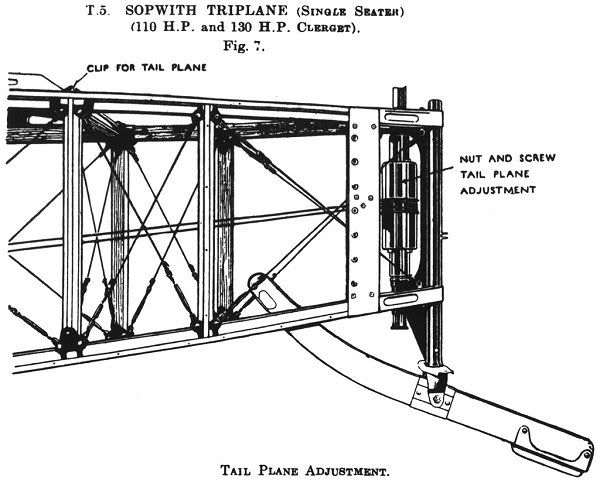 The second showing the Biff's mechanism (Bristol F.2B): 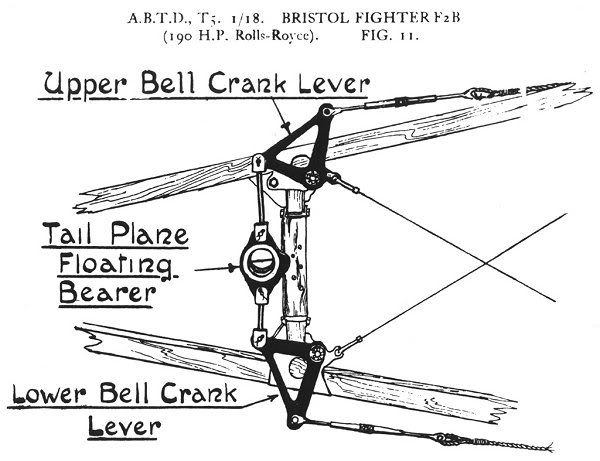 (hey, just tryin' to keep the thread on the front page......for Copterdrvr) 
|
|
|
|
|
Joined: Oct 2001
Posts: 2,343
Member
|
|
Member
Joined: Oct 2001
Posts: 2,343 |
Thanks Dude. But hey, great info-where did you find those cool illustrations? Copterdrvr
Skids are for kids!
|
|
|
|
|
Joined: Feb 2001
Posts: 1,657
Member
|
|
Member
Joined: Feb 2001
Posts: 1,657 |
TKS FlyXwire. I like the diags. Could whole models be built from the whole set? If so then what's the source! Just rigging those things was an art claimed lost once. At least I think that at Old Rhinebeck they do rig the planes? And then the stick was trim in the earlies if you take wing warping as trim. Thing is, you hadta hold it there. IMO it's purer flying them WWI planes. 
|
|
|
|
|
|
Anonymous
Unregistered
|
|
Anonymous
Unregistered
|
Hi,
just to complete any confusion left ...
Precession is what the vertical axis of e.g. a spinning top or gyro or the earth does when the axis tumbles. The bigger the angle the bigger the precession.
If you want to overcome the inertia of a fast rotating body you need more force than for the inertia of a still one (inertia along certain directions rises with rotation). Since the rotating engines of WW1 planes are not very long (=short axis), a plane like the pup or Camel is still able to do quick course changes.
However this has not much to do with the Camel's behaviour to go down in right, and up in left turns. The latter one derives from the added gyroscopic effect to the inertia, and the resulting torque, not precession.
The clockwise turning engine (in direction of flight) simply assists the plane when doing a right turn, in turning the whole plane to the right along its axis. If you want to turn to the left, the engine does not only not assist you, but you have to additionally overcome the engines torque, resulting in a rise, or a long rising turn, if not countered. Astonishing enough this was better modelled in RB "1" and in MS's flight sim #4 than in any other sims i know of.
There are certainly other things to regard, like propwash etc., and on the ground the axis' angle is greater than 0 in relation to movement ...
Greetings,
Catfish
|
|
|
|
|
Joined: Jul 2001
Posts: 1,080
Member
|
|
Member
Joined: Jul 2001
Posts: 1,080 |
Originally posted by Narsinha:
The clockwise turning engine (in direction of flight) simply assists the plane when doing a right turn, in turning the whole plane to the right along its axis. If you want to turn to the left, the engine does not only not assist you, but you have to additionally overcome the engines torque, resulting in a rise, or a long rising turn, if not countered. Well that does complete the confusion, because torque is transmitted in the opposite direction of the engine's rotation, and so will roll the aircraft to the left and not to the right (viewed from along the direction of flight). I think it's time for all of us to start preparing ourselves for our initial solo flight in "Knights", and so I've quoted this passage below that nicely sums up some of the discussion we've been having these past few days on video clips, rotary blipping, engine torque, gyroscopic precession, and even airframe rigging (it's from the 1918 flight manual "Practical Flying"): Sometimes during the last few hundred feet the pupil may use his engine the better to gauge his distance. In switching on and off, or, as it is commonly called, " blipping " an engine, either on the ground or in the air, the pilot will notice that the lateral balance of the machine is temporarily upset and that one wing will rise and fall as the engine is switched on and off. This is due to what is called the torque of the propeller. If the propeller revolves in a clockwise direction, judged from the pilot's seat, it creates an opposite turning movement of the machine, which will tend to revolve about its longitudinal axis in an anti-clockwise direction. Unless due allowance were made for this the machine would fly left wing down. But to compensate for the torque of the propeller more lift is given the left wing by increasing the incidence, or giving it what is called a "wash in." The greater lift allows the machine to fly laterally level, despite the propeller torque. When the engine is switched off for descending, the torque decreases, and so the left wing with the greater lift will tend to rise momentarily. When an engine is being "blipped" on the ground, the same sideways rock of the wings will be noticed. When the engine is on, the wing will drop, to rise again level as soon as the switch is off.Hey enjoy the book guys, because you can also access it online! http://www.warillustrated.com/practicalflying/
|
|
|
|
|
Joined: Mar 2002
Posts: 7,247
Hotshot
|
|
Hotshot
Joined: Mar 2002
Posts: 7,247 |
Did Gennadich mention what kind of copy protection they plan to use for this WW1 sim ??
|
|
|
|
|
Joined: Oct 2001
Posts: 2,343
Member
|
|
Member
Joined: Oct 2001
Posts: 2,343 |
And as someone mentioned(correctly)earlier, the effect of the force applied to the rotating mass is felt 90 degrees after the input.
Take a helo for example. To make the a/c move forward, the rotor disk must be tilted forward. The pilots input through the cyclic is made on the left side of the helo. The resultant action takes place on the aft portion of the rotor disk causing it to tilt forward.
Copterdrvr
Skids are for kids!
|
|
|
|
|
Joined: Sep 2004
Posts: 10,618
Babelfish Immune Veteran
|
|
Babelfish Immune Veteran
Joined: Sep 2004
Posts: 10,618 |
Yes FlyXwire my understanding is that if the prop turns clockwise from the pilot's POV then rolling left uses engine torque for extra turning-goodness: while rolling right you're fighting against engine torque trying to roll the aircraft left. This works even in mid-air Ming
'You are either a hater or you are not' Roman Halter
|
|
|
|
|
|
Anonymous
Unregistered
|
|
Anonymous
Unregistered
|
Hello,
look ... the engine (turning) is based on the crankshaft (fixed), so if you accelerate the engine it will brace itself (or stem itself?) against the crankshaft, pushing this in the other direction (and thus rolling the plane to the opposite), as well it will react counterwise during a rapid deceleration (e.g. blipping).
However this is true for drastic revolution changes. This is what is described in the flight manual (Good link b.t.w.!).
As long as the engine runs with a fixed speed there is no torque to feel, you only have to fight the inertia during course changes.
And if you roll to the right without de- or accelerating, the engine supports it, taking the plane with it, and lowering your right wing, so the plane will lower the right wing, and make a banked right turn lowering the nose.
If you roll to the left you roll the plane including the crankshaft against the motion of the engine, which needs more power and will force the plane to raise its nose.
You can assist the plane by cutting the engine during a right turn, this will result in a very tight turn. Additionally you can give full power which will assist turning the plane to the left.
I think that's the way it works ...
Greetings,
Catfish
|
|
|
|
|
|
Anonymous
Unregistered
|
|
Anonymous
Unregistered
|
Hello,
whoa, well i had to work my way through this, and still am. But i think he only talks about propellor torque (?), a rotating engine does generate more force. Apoart from the earth's gravitation (or better acceleration) there's the earth's own rotation (coriolis) which adds to the forces. And just for the "bump" of it.
Greetings,
Narsinha
|
|
|
|
|
Joined: Jul 2001
Posts: 1,080
Member
|
|
Member
Joined: Jul 2001
Posts: 1,080 |
LOL.....yes, must add in the earth's rotation, and the gravitational pull too......or as you say it "where the ocean meets the sky".
|
|
|
|
|
Joined: Sep 2004
Posts: 10,618
Babelfish Immune Veteran
|
|
Babelfish Immune Veteran
Joined: Sep 2004
Posts: 10,618 |
i think he only talks about propellor torque (?), a rotating engine does generate more forceThere is only engine torque turning the transmission Narsinha, the mobile axle which turns the prop one way and the plane (mounted solidly to the engine) the opposite way. The prop is not solidly mounted to the plane it's free to rotate in its little highly-greased world. But constrained to one axis that moves around a bit like Hancock's gravy The engine turns the prop and the prop turns the work done into friction acting on the atmosphere, leverage. Which shoves the plane in a counterwise angular direction of rotation to the propshaft's direction of rotation. Leverage is the thing. The propshaft is the transmission device from engine to propellor and the propellor is the transmission device from engine to atmospheric-leveraging Hmmm wait a minute where does this leave four-wheeled vehicles with two wheels turning one way and two turning the other way. How do ground vehicles move then lol. Ah the motive horse is pulling in the velocity vector direction the wheels do no work they are passive devices. That should be straight ahead I've been told to say Ming
'You are either a hater or you are not' Roman Halter
|
|
|
|
|
|
Anonymous
Unregistered
|
|
Anonymous
Unregistered
|
Hello, i understand what you all mean, and i can fly with it, however i wonder what really happens. Certainly forget gravitation and Coriolis effect lol. "There is only engine torque turning the transmission Narsinha, the mobile axle which turns the prop one way and the plane (mounted solidly to the engine) the opposite way." Which is somehow clear, but since the propellor has a tiny mass in relation to the rest of the plane, it certainly turns easier, and that's why the prop rotates, and not the plane. It does have an effect on the plane though, admitted. "The prop is not solidly mounted to the plane it's free to rotate in its little highly-greased world." I even understand that lol. "But constrained to one axis that moves around a bit like Hancock's gravy" Yeah right. It moves as soon as the plane does any course change. Or do you mean it would move if you'd let it free ? It would stabilize like a spin top then, which, in this case, is really based on the earth's gravitaion. "The engine turns the prop and the prop turns the work done into friction acting on the atmosphere, leverage." I can accept that, even with rotary engines the engine turns the prop, be it itself (rotary) or via a crankshaft (in line or v-shaped), ok. "Which shoves the plane in a counterwise angular direction of rotation to the propshaft's direction of rotation. Leverage is the thing. The propshaft is the transmission device from engine to propellor and the propellor is the transmission device from engine to atmospheric-leveraging" Yes but that's what i wrote (rotating engines): the engine has to stem itself against something when accelerating - a rotating engine will transfer its momentum to the fixed crankshaft, and tries to turn the plane in the anti-clockwise direction, especially when the engine is heavy, and has a lot of mass. The mass of a rotating engine revving at a fixed rpm with say 1400 rpm with its fixed propellor will also stabilize level, or better straight flight, acting like a gyroscope. Greetings, Narsinha
|
|
|
|
|
Joined: Jul 2001
Posts: 1,080
Member
|
|
Member
Joined: Jul 2001
Posts: 1,080 |
Originally posted by Narsinha:
However this has not much to do with the Camel's behaviour to go down in right, and up in left turns. The latter one derives from the added gyroscopic effect to the inertia, and the resulting torque, not precession.
The clockwise turning engine (in direction of flight) simply assists the plane when doing a right turn, in turning the whole plane to the right along its axis. If you want to turn to the left, the engine does not only not assist you, but you have to additionally overcome the engines torque, resulting in a rise, or a long rising turn, if not countered. Narsinha, the above quote states your initial thinking (not the opposite). Now please, there's nothing wrong with allowing oneself to think about a process from a different "angle", and as John Denker summarizes, our early thinking about torque or gyrocopic precession is often based on intuition: For any normal object (such as a book) if you apply a force in a given direction, it will respond with motion in that direction. People are so accustomed to this behavior that they lose sight of the fact that force and motion are not exactly the same thing, and they don�t always go togetherFurther: Originally posted by Narsinha:
As long as the engine runs with a fixed speed there is no torque to feel, you only have to fight the inertia during course changes. This is not correct, because torque is also a "reactive" force, and is present when the engine/prop is turning, and does affect flight direction unless compensated for (either by the pilot, or by the plane's design, or both). On the otherhand, it is gyroscopic precession which occurs only at certain times during prop and/or rotary-engined flight, again Denker: Gyroscopic effects only occur when the there is a change in the orientation of the gyro�s plane of rotation. You can take a gyro and transport it north/south, east/west, or up/down, without causing any precession, as long as the gyro�s plane of rotation remains parallel to the original plane of rotation. You can even roll an airplane without seeing gyroscopic effects due to engine rotation, since the roll leaves the engine�s plane of rotation undisturbed.As I tried to impress in an earlier post: "First, all reciprocating engines that rotate a crankshaft/flywheel/and/or their outer casing (as with inline and rotary aircraft engines) produce "torque". You car engine produces torque, an electric motor produces torque, even the rubber band power for a balsa model airplane produces torque, however, torque is not the same as gyroscopic precession. Therefore there are specific and different forces involved when talk turns to engine "torque", and when people start to talk of what was called "rotary torque" during WWI (that earlier term is a poor and confusing description, and probably why prolonged confusion continues). Rotary torque describes gyroscopic precession, which is a force that is encountered (felt) when a spinning mass is rotating in one plane, and an external force attempts to move it out of it's rotating axis of motion (outside it present rotating plane). Torque is a constant force when motive power is spinning, but gyroscopic precession is only experienced when changes in direction of its axis of rotation are changed, otherwise it's generally not even perceived." So in the final analysis, the Camel's turning ability was very much affected by precession, and by torque, and by CG, and by it's rigged instability, and, and..... Hey, there's been no problem in keeping this thread "front and center" now these past days.......but I hope that's been a good thing. 
|
|
|
|
|
Joined: Sep 2004
Posts: 10,618
Babelfish Immune Veteran
|
|
Babelfish Immune Veteran
Joined: Sep 2004
Posts: 10,618 |
an external force attempts to move it out of it's rotating axis of motionIn this case the external force is that of air friction always present pushing back on the propellor blades against the engine torque before any changes of direction leading to precession come into it One thing that confused me early on was a lecturer explaining that there is a real force acting in the upward direction when you are standing still, pushing you up... couldn't understand that at all, big mystery. Once you twig that if you are stationary under gravity there MUST be an equal force 'pushing' you upwards against gravity. Or you'd be falling. Forces don't always have to be moving things around. Things can be in a state of balance just lying there but they're being pushed around lots really if you look carefully Ming
'You are either a hater or you are not' Roman Halter
|
|
|
|
|
Joined: Jul 2001
Posts: 1,080
Member
|
|
Member
Joined: Jul 2001
Posts: 1,080 |
Originally posted by Ming_EAF19:
In this case the external force is that of air friction always present pushing back on the propellor blades against the engine torque before any changes of direction leading to precession come into it Exactly Ming......and as often happens in forum discussions, there were too many "points' being discussed at the same time.
|
|
|
|
|
Joined: Sep 2004
Posts: 10,618
Babelfish Immune Veteran
|
|
Babelfish Immune Veteran
Joined: Sep 2004
Posts: 10,618 |
Planes made of wood and canvas flown by early-twentieth-century-fed pilots "I am NOT eating THAT!" plus half a gallon of two stroke and a service revolver. I'm expecting massive torque Ming
'You are either a hater or you are not' Roman Halter
|
|
|
|
|
Joined: Nov 2004
Posts: 2,494
Member
|
|
Member
Joined: Nov 2004
Posts: 2,494 |
Rather than the idealized and docile "Red Baron" flight mode, that WWI "knights of the sky" purity comes with a price: Temperamental beasties, with a narrow set of allowable flight parameters, always trying to find a way to kill you. Can't wait.  Papa_K
|
|
|
|
|
|
|
|
|
|
|
|
|
HOA's
by Terl9999 - 09/18/26 04:12 AM
|
Football
by Terl9999 - 09/18/26 02:42 AM
|
Flags
by Terl9999 - 09/15/26 10:03 PM
|
|
|
|
|
|
|
|